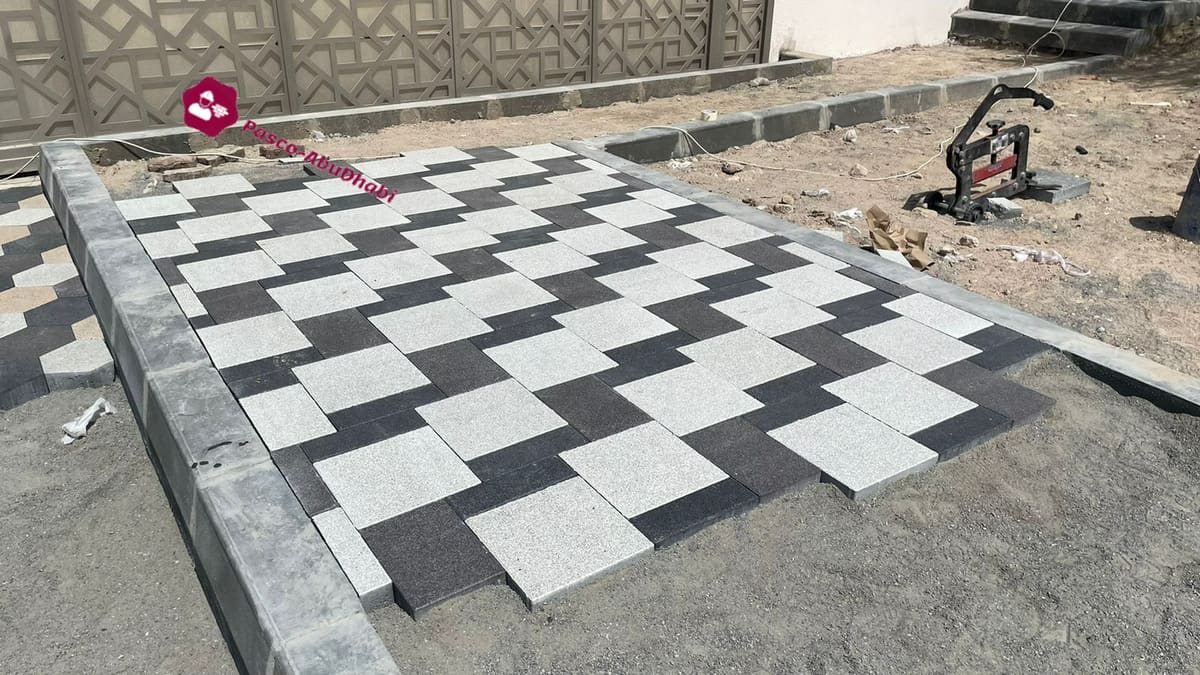
A villa driveway is the hardest-worked surface on the plot and the first thing anyone sees. It takes the full weight of vehicles, it takes them turning on the spot at the gate, it sits in direct sun all day, and it has to shed water away from the building on the rare occasions it rains. Interlock handles all of that well - provided the block, the thickness and the base underneath are specified for traffic rather than for looks. This page covers what that means in practice.
Why interlock rather than poured concrete or asphalt
A concrete slab in this climate cracks, and a crack cannot be repaired invisibly - it is patched, and the patch is permanent. Interlock is a surface of individual blocks over a flexible bed, so it absorbs movement across its joints instead of cracking, and any damaged area is lifted and relaid in the same blocks. That also matters for services: when a pipe or cable has to be reached, the blocks come up, the trench is opened and the same blocks go back down. With a slab you would be cutting and patching. Asphalt softens in the heat and offers you one colour.
The design: Behaton or UNI Blocks
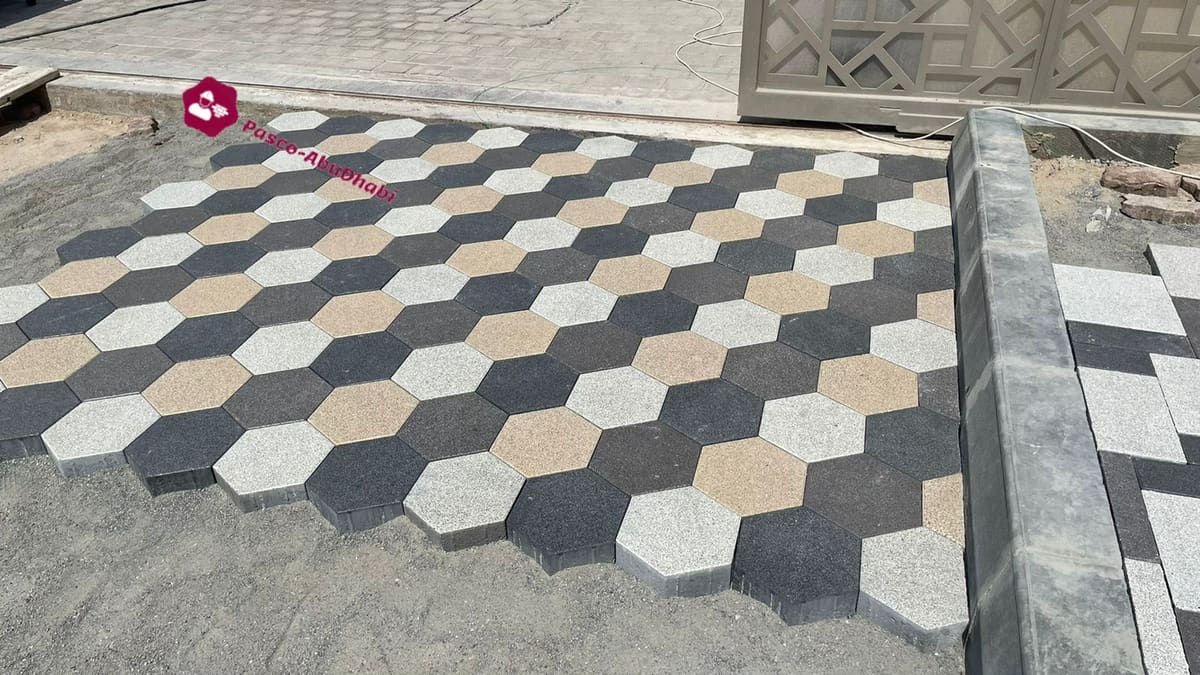
For anything vehicles drive over, we put forward Behaton, which locks on four sides, or UNI Blocks, which lock on two. Turning traffic at a gate is what tests a surface hardest, so Behaton is the safer choice where cars manoeuvre. Decorative designs - Quadro, Lotus, Ventagilio - belong on the courtyard and walkways beside the driveway, not under the wheels, and pairing a hard-wearing driveway with a decorative courtyard in a shared colour is how most villas we do are laid out.
The base is where driveways are won or lost
Most failed driveways are not failed blocks. They are a base that was not excavated deep enough or not compacted properly, an edge that was never restrained, or falls that send water at the building instead of away from it. Our sequence is the same every time: excavate or fill to the required level, grade and compact the base with the falls set, install kerbstones or a concrete edge, screed the sand bed, lay and cut, then plate-compact the surface and brush fine joint sand in. That last step is what actually creates the interlock - a surface that has not been compacted and jointed is not finished.
Edges, gates and drainage
The driveway edge is the most likely place for a surface to start moving, which is why it gets a kerbstone or a concrete edge beam rather than being left free. Gate tracks, drainage channels, manholes and inspection covers all need cutting in, and they are worth pointing out when you ask for a price because they are real work. Where the driveway meets the road crossing, levels have to pick up the existing kerb line.
Colour that still looks right in five years
Driveways collect tyre marks, dust and the occasional oil spot. Very pale blocks show all three; solid black absorbs heat and shows dust. Mid greys, beiges and terracotta tones age most gracefully, which is why they are what we lay most often, with a darker border to define the edge. Keep a few spare blocks from the same batch: colour shifts slightly between production runs, and a replacement from a later batch never quite disappears.
Maintenance, honestly
Wash it down occasionally and top up the joint sand when you notice it has thinned - that is essentially it. A cracked or stained block is swapped out on its own. There is no sealing regime you have to keep up with and nothing that needs resurfacing on a cycle.
Driveway and parking work


Ready for a figure on your own site? Request a quotation - seven short questions - or send the details straight to us on WhatsApp. The full product page is interlock supply and installation.
Written by the Pasco Stones team in Abu Dhabi. The same guidance in Arabic: هذه الصفحة بالعربية.